
Stuttering affects around 1% of adults, yet people who stutter still face stereotypes, social exclusion, and discrimination. They’re often seen as shy, nervous, or less capable – not because of who they are, but because of how they sound.
Education can improve public attitudes. But could a social robot make this learning more engaging and memorable?
A new study in ACM Transactions on Human–Robot Interaction explored exactly that question, using QTrobot.
What did the researchers want to know?
- A social robot can improve people’s attitudes toward people who stutter
A robot works better than a tablet alone, or just as well
A robot that imitates stuttering changes attitudes or empathy differently than a fluent robot
Because this is a brand-new application of social robots, the study was designed as an exploratory first step.
How was the study set up?
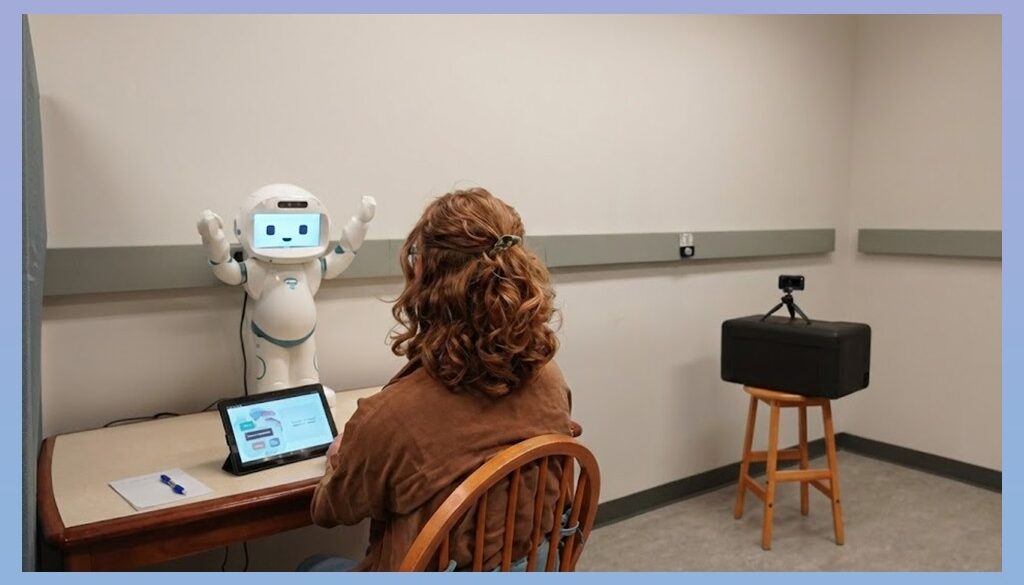
The researchers created an interactive presentation about stuttering and delivered it in three ways:
Robot + tablet – QTrobot spoke and presented the content, while a tablet showed visuals and quizzes
Robot that sometimes stutters + tablet – same setup, but QTrobot occasionally imitated stuttering, showing what it can sound like
Tablet only – exactly the same voice and content, but no robot, just audio and visuals on a tablet
What did they find?
1. All three approaches improved attitudes: After the presentation, attitudes toward people who stutter improved in all conditions. Participants saw people who stutter more positively, and they suggested more supportive behaviours like “be patient,” “don’t interrupt,” and “give people time to speak”. This shows that good educational content can make a real difference, whether it’s delivered by a robot or a tablet.
2. Robot vs tablet: similar impact, different experience: On attitude change alone, there was no major difference between the 3 groups. In other words, content was the key driver of change.
But when it came to how the technology felt, QTrobot clearly stood out. Participants rated the robot as warmer, more attractive and stimulating and more novel than the tablet. Many people said the robot’s presence, gestures and expressions helped keep their attention and made the experience more engaging.
3. A stuttering robot is acceptable and helpful for understanding: Participants did not react negatively to the robot imitating stuttering. Many felt it made the presentation more realistic and helped them better understand the different features of stuttering
The stuttering robot did not produce significantly larger attitude changes than the fluent robot, but it added extra clarity and realism for some learners.
Why does this matter for social robots and inclusion?
This is the first study to show that a social robot like QTrobot can:
Deliver stigma-reducing education about stuttering
Improve public attitudes
Offer an experience that people find warm, engaging and memorable
The results suggest exciting possibilities:
Robots can support not only individual therapy and learning, but also wider awareness and inclusion
Similar approaches could be explored for other conditions where stigma is a problem, such as autism or mental health
Co-design with people who have lived experience is essential to ensure respectful, empowering use of technology
Reference:
https://dl.acm.org/doi/full/10.1145/3722122